Release Notes 2026
October 2026
September 2026
August 2026
July 2026 Release
June 2026
May 2026
April 2026
March 2026
February 2026
Frequently Asked Questions!
How do I see descriptions of codes in enquiry screens?
How do I access field level help?
How can I delete a payment run
How do I stop over receipting of orders
Why has my transaction not appeared on the payment run?
How do I stop a user posting to a prior and future period
How to copy and delete lines during data entry?
Prevent user posting to specific balance classes
Download Templates
User setup requires multiple screens and is complicated!
Changing security access to a user
Out of office
How do I give a user read only access?
De-allocate and an AP Payment
Can I run a report to view security groups against my users?
Hints and Tips!
Useful information to include when raising Financials cases
Navigation Hints and Tips
Browse Timeouts
Accounts Payable Quick Cards
Accounts Payable Supplier File
Accounts Payable Data Entry
Log Invoice/Credit Note
Enter a logged Invoice
Non Purchase Order Related Invoice Entry
Order Related Invoice
Order Related Invoice with Mismatches
Order Related Invoices - mismatch scenarios
Mismatch Types
Invoice and Credit Note Matching
Accounts Payable Enquiries
Accounts Payable Payments
Payment Processing
AP Payment Cancellation
Create a manual payment
Re-run Bacs Remittance
Cancel a full BACS payment.
Payment Processing Audits
Single Supplier Payment Processing
Transaction Maintenance
CIS Processing
Accounts Payable Code Tables
Accounts Receivable Quick Cards
Customer Maintenance
Data Entry and DDI Mandates
Enquiries
Cash Allocation
Credit Control
Student Sponsor
General Ledger Quick Cards
Chart of Accounts Setup
Create a new nominal code
Create management and analysis codes
Creating and Amending Nominal and Management code relationships
Create a new GL Structure Element
General Ledger Data Entry
Journal Entry
Journal Upload
General Ledger Journal Multi Level Authorisation
Modernisation Budget Upload
General Ledger Enquiries
Account Details
Trial Balance
GL Enquiries - Balance Sheet & Profit and Loss
Enquire across multiple years
Transactions Enquiries
Period and Year End Close
General Ledger Security
General Ledger Tax Journals
Fixed Assets Quick Cards
Prompt File - Asset Creation Updated
Fixed Assets Period End & Depreciation Updated
Revaluation
Disposals
Relife
Purchasing Management Quick Cards
Inventory Management Quick Cards
Return to Store
Stock Taking
Create Demand on Store (Financials)
Bin Transfers
Stock Disposal
Stock Adjustments
Import Tool Kit
Reconciliation Processes - Helpful how-to guides
Daily Checks
General Ledger Reconciliation Reporting
Accounts Payable Reconciliation Reporting
Accounts Receivable Reconciliation Reporting
Fixed Assets Reconciliation Reporting
Purchasing Management Reconciliation Reporting
Procurement Portal
Procurement Portal Overview
Navigation
Requisitions
Orders
Authorisation
Receiver
Invoice Clearance
Portal Administration
Procurement Portal – Teams Setup
Invoice Manager
Bank Reconciliation
Bank Reconciliation Overview
Bank Reconciliation Menus Explained
Bank Reconciliation Company Controls
Bank Reconciliation Code Tables
Transaction Types and Sub Types
Bank Reconciliation Enquiries
Bank Reconciliation Reports
Manual Bank Reconciliation
Bank Reconciliation Take-on
Unmatching Transactions
Reporting
General Ledger Reports
Account Payable Reports
Fixed Assets Reports
Sales Invoicing Reports
Accounts Receivable Reports
Bank Reconciliation Reports
Purchase Invoice Automation (PIA)
February Release
March Release
January 2026
Deleting Supplier training data
Resetting password - Smart Workflow
Purchase Invoice Automation (PIA)
Adding a New User - Smart Workflow
Password Reset in Smart-Capture
How to Create a New User in Smart-Capture
Reprocessing Failed OCR Supplier Invoices
Smart Capture Email Configuration Overview
Configuring Smart Capture to use Gmail in the Web UI
MAP Configuration Non-Microsoft and Non-Google Accounts
Configuring Smart Capture to use Microsoft 365 (Graph API) in the Web UI
Suggested Testing Areas
Release Notes - New UI Improvements
June Release 2024 - New UI Improvements
May Release 2024 - New UI Improvements
April Release 2024 - New UI Improvements
Release Notes 2025
December 2025
November 2025
October 2025
September 2025
August 2025
July Release
June Release
May 2025
April 2025
March 2025
February 2025
January 2025
Release Notes 2024
December 2024
November 2024
October 2024
September 2024
August 2024
July 2024
June 2024 Release
May 2024 Functional Changes
Financials Design Improvements
User Interface Overview
Chart Functionality
User Preference Improvements
Alerts & Field Error Focus
The all new Data Grid!
Input Fields & Dynamic Validation
Screen Structure
Miscellaneous New Features
Generic Actions
Bring Your Own BI (BYOBI)
Collaborative Planning
Financial Reporting Consolidation
Flow Headstart Forms
Request a Customer
Request a Supplier
Request a Sales Invoice
Request a Management Code
Request a nominal code
Create a Pay Request
API
Air Approvals
- All categories
- General Ledger Quick Cards
- General Ledger Security
- General Ledger Account Code restriction across the system
General Ledger Account Code restriction across the system
 Updated
by Caroline Buckland
Updated
by Caroline Buckland
For General Ledger Account Code restriction across the system
GL Range Codes must be created. GL Range Codes are used to define a group/list of codes. Each account code segment will need to be setup separately by selecting the correct code ID and entering the range.
GL Access Codes must be created. An Access Code is made up of a formula that brings all four range codes together, which defines the access/visibility.
A GL Security Group Access Code must be linked to the STD or PORTALS Security Group. The Security Group is linked to the Access Code and it is the Security Group that is assigned to a user’s record within Financials. Once assigned, the user must log out of Financials, log back in and where a restriction was set, results in the user no longer being able to view the codes listed in the GL Range Code.
Example:
Chart of Accounts Account Code Setup: Cost Centre (Code ID A), Nominal (Code ID B), Project (Code ID C) and Detail (Code ID D)
A Company wishes to restrict certain Cost Centres from being used by users but is happy for all other codes to be accessed and used.
To achieve this, four GL Range Codes need to be setup to represent the Account Code setup above.
Set up a GL Range Code for the Cost Centre codes, based on Code ID: A, with a List Code of COSTLIM.
Set up a GL Range Code for all other code IDs, B, C and D, these lists should contain a range to capture all codes within those segments.
End Result: Range Code List for COSTLIM (your limited cost centre list), BALL (all nominals), CALL (all project codes) and DALL (all detail codes).
Set up an Access Code to bring all of the Range Codes together via a formula.
The Access Code would be (BALL & CALL & DALL) ! COSTLIM.
For module specific restriction across the system
Select the Module that the security will apply to.
Module Range Codes must be created. Here, the code ID represents something other than a General Ledger account code. For example, if the code ID chosen represents Supplier, the range code would include a supplier code or codes.
Module Access Codes must be created. An Access Code is made up of a formula that brings all four range codes together, which defines the access/visibility.
A Module Security Group Access Code must be linked to your Security Group. The Security Group is linked to the Access Code and it is the Security Group that is assigned to a user’s record within Financials. Once assigned, the user must log out of Financials, log back in and where a restriction was set, results in the user no longer being able to view the codes listed in the GL Range Code.
Example:
A Company wishes to restrict certain Supplier Codes from being used by users as they are Employee records.
Set up a Module Range Code for all suppliers with a List Code of SUPPS.
Set up another Module Range Code for the supplier codes that should be excluded. For example, EMP0001 and EMP0002 with a List Code of SUPPSLIM.
Set up an Access Code to bring the Range Codes together via a formula.
The Access Code would be SUPPS ! SUPPLIM.
Access Code Expressions
Enter the range list code(s) associated with the access code. If using multiple range list codes, they must be joined using one of the following symbols:
+: or
&: and
!: except
Example - Create a Range Code
In this example we are restricting access to payroll nominal codes.
Data on the system is as follows:
Account Definition is as follows:
A = Cost Centre, B = Nominal, C = Fund, D = Project
Payroll nominal accounts are in the range of 1001 - 1012
Navigate to: Systems Admin > System Wide Controls > Users & Roles > Security > GL Range Codes
Select Insert.
Enter the following data:
Range List Code.
Description.
Enter a Code ID: The available options are A-D (representing the account code segments) and 0-1 (representing the Analysis Code segments)
Enter the From Value and To Value: If an individual value is being entered then enter the same value into both places. If a range of codes needs to be captured, the From Value must hold the first value in the sequence and the To Value must hold the last. Multiple ranges can be entered if required.
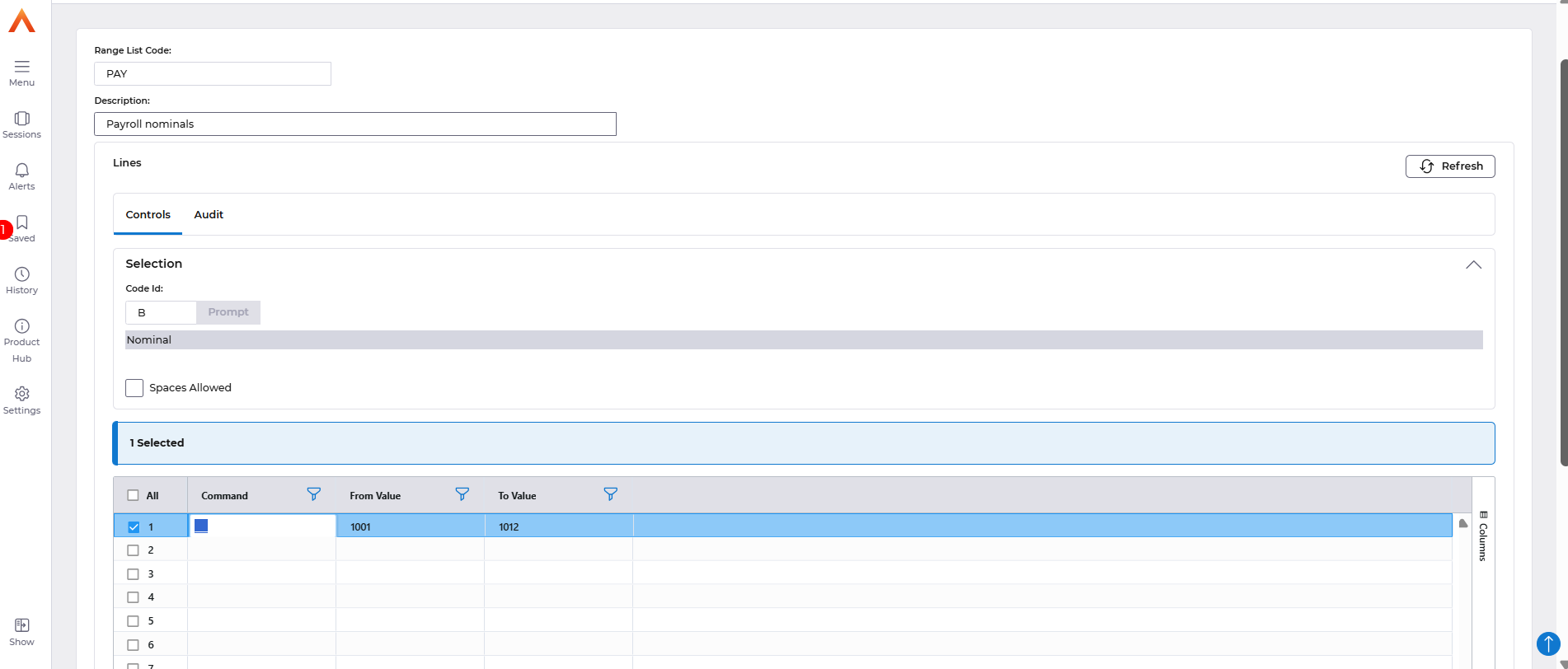
Select Save.
Example - Create a GL Access Code
Navigate to: Systems Admin > System Wide Controls > Users & Roles > Security > GL Access Codes
Select Search.
Select Insert.
Enter the following data:
Access Code.
Description.
Enter an Access Code Expression: This should exclude the range code that you created above as this range includes the codes that should not be visible to a user.
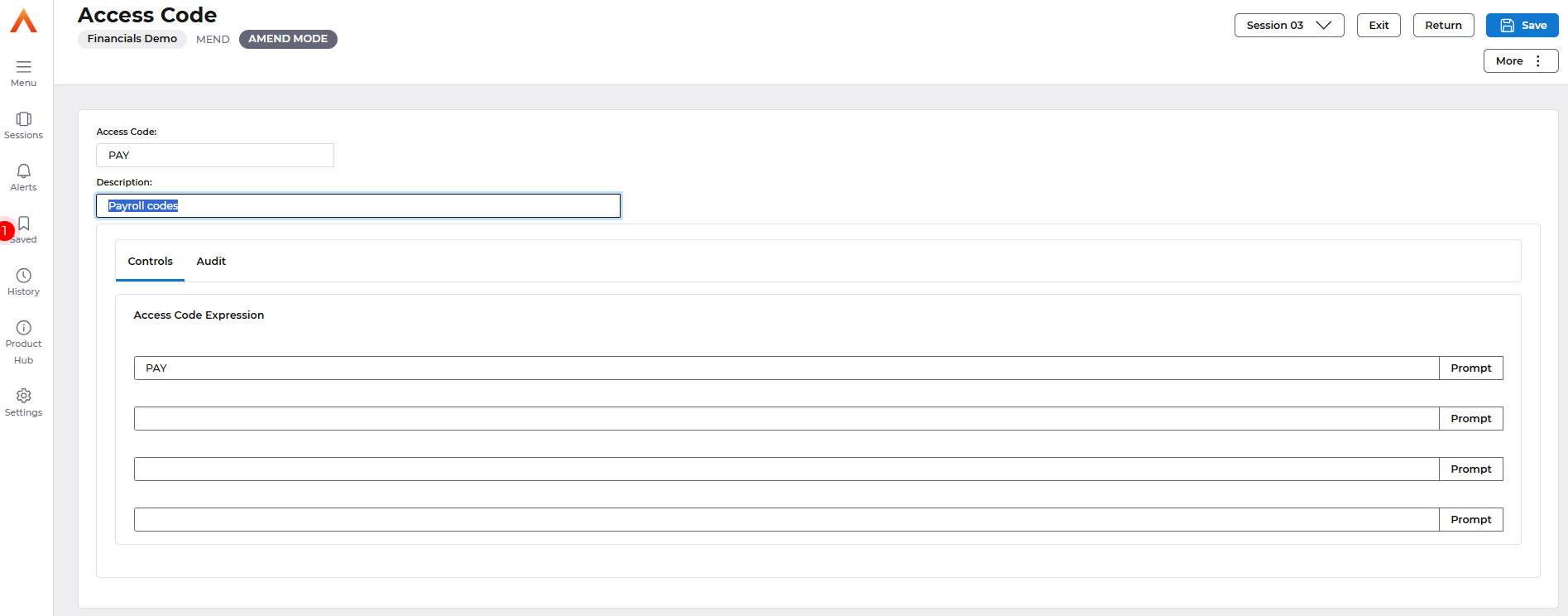
Select Update.
Example - Create a GL Security Group Access Code
Navigate to: Systems Admin > System Wide Controls > Users & Roles > Security > GL Security Group Access Code
Enter the following data:
Select Insert.
Security Group: Select the security group that the access code should be attached to. All users in the system will be set up against for example the STD (Standard) or the PORTAL (Procurement Portal) Security Group. Choose PORTAL in this example.
Path Code: Set to 0.
Update Access Code: Enter the security group code here.
Enquiry Access Code: Enter the security group code here if the system should follow your new rule in enquiries.
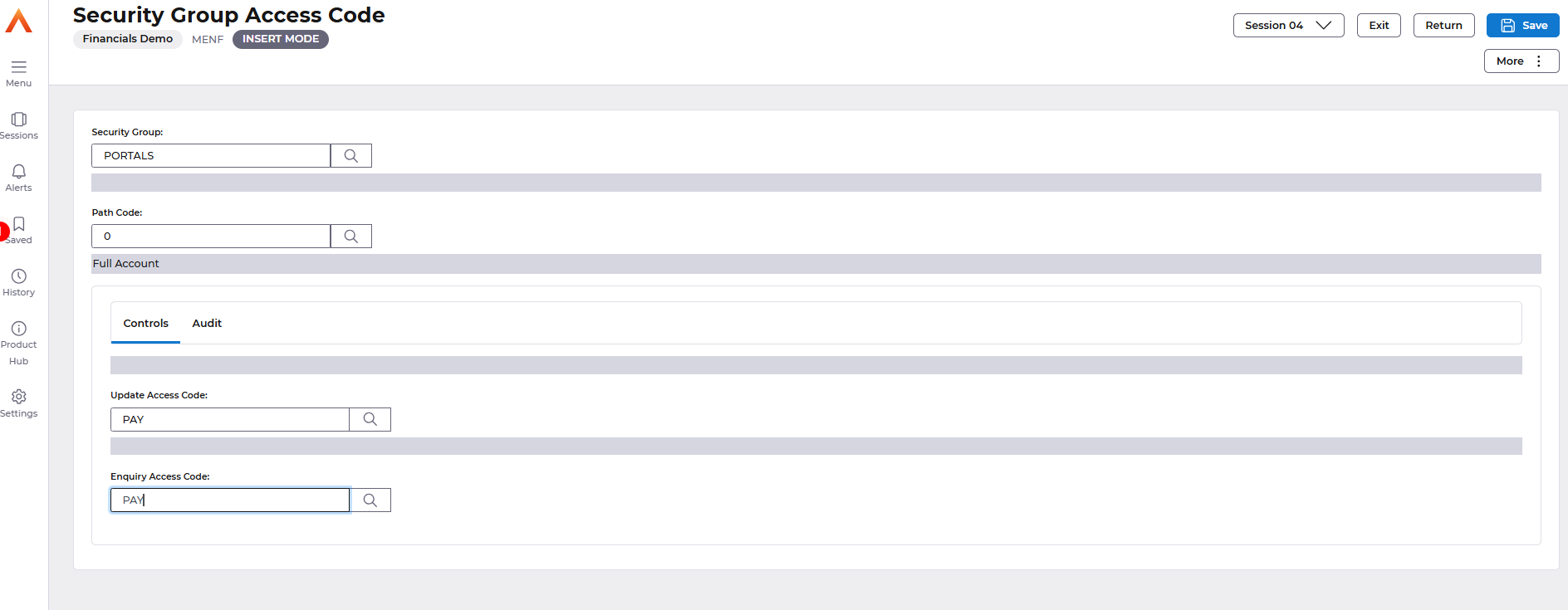
Select Save.
Repeat the above steps another 4 times, for different Path Codes. You will end up having 5 entries for your new Access Code for the following Path Codes:
0, 1, 2, 3 and 4 .
Example of more than one range code
In this example we now setup a range code to restrict some access to a cost centres, but allow access to all other cost centres.
Follow the steps for in the Create a range code example but replace the following:
Code id = A for cost centre
Enter the From and To range. This example we are only restricting one cost centre.
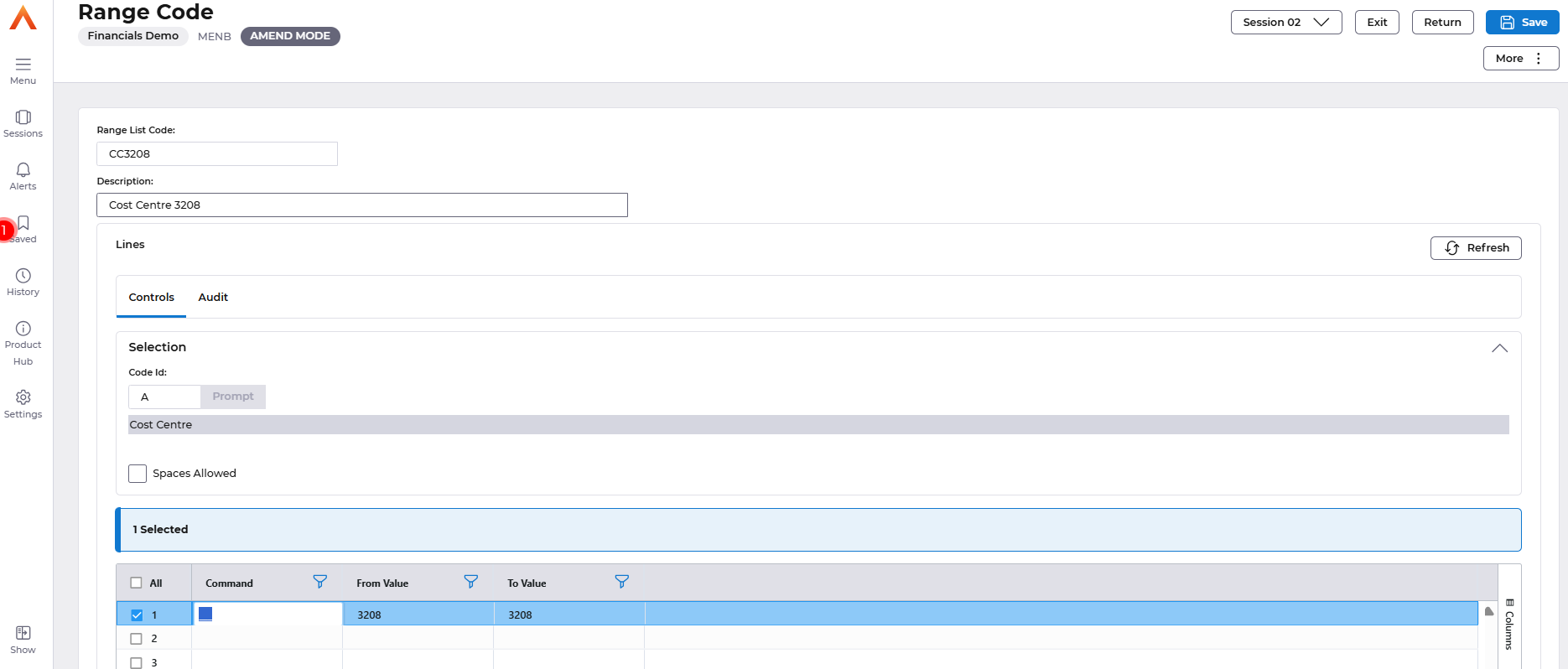
Save once complete.
Set up a range code to represent All Cost Centres.
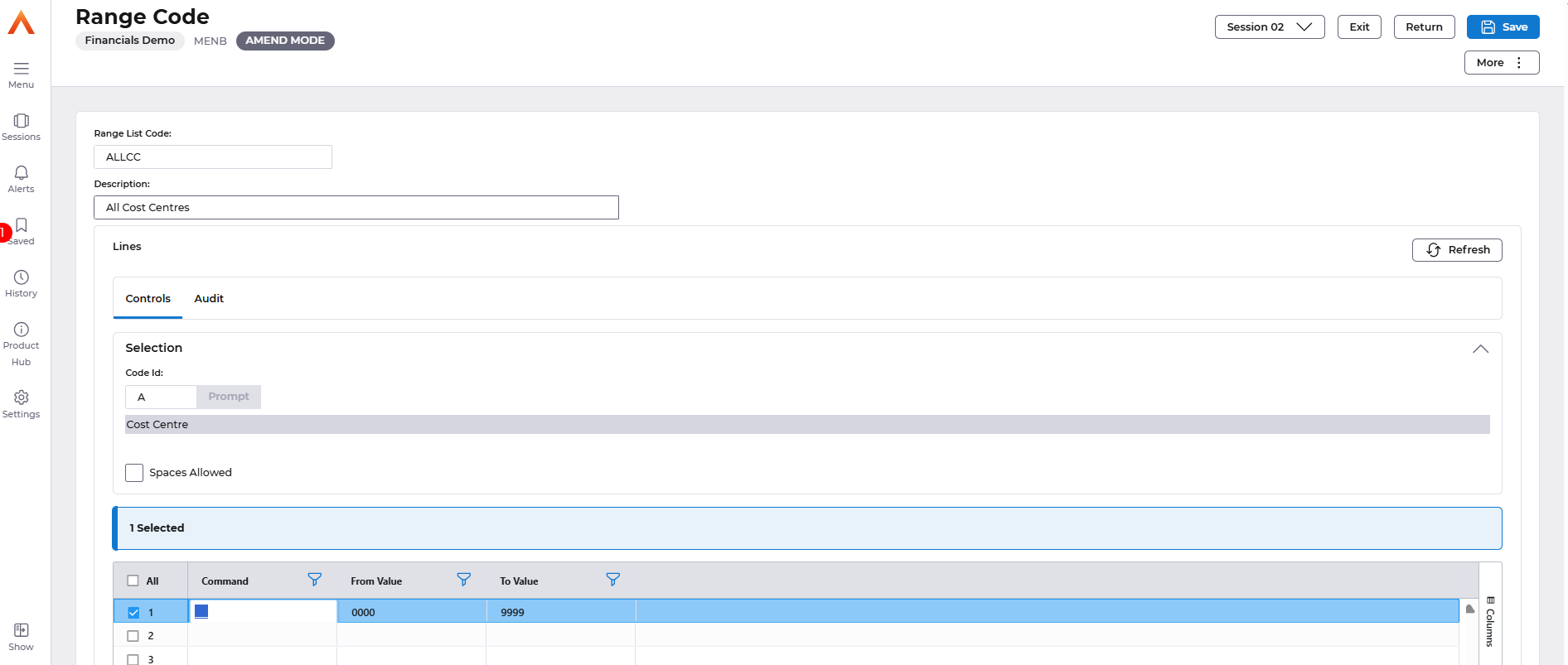
Save once complete.
The Access code could then be setup as follows.
ALLCC!CC3208
This will allow access to all cost centres but not cost centre 3208.
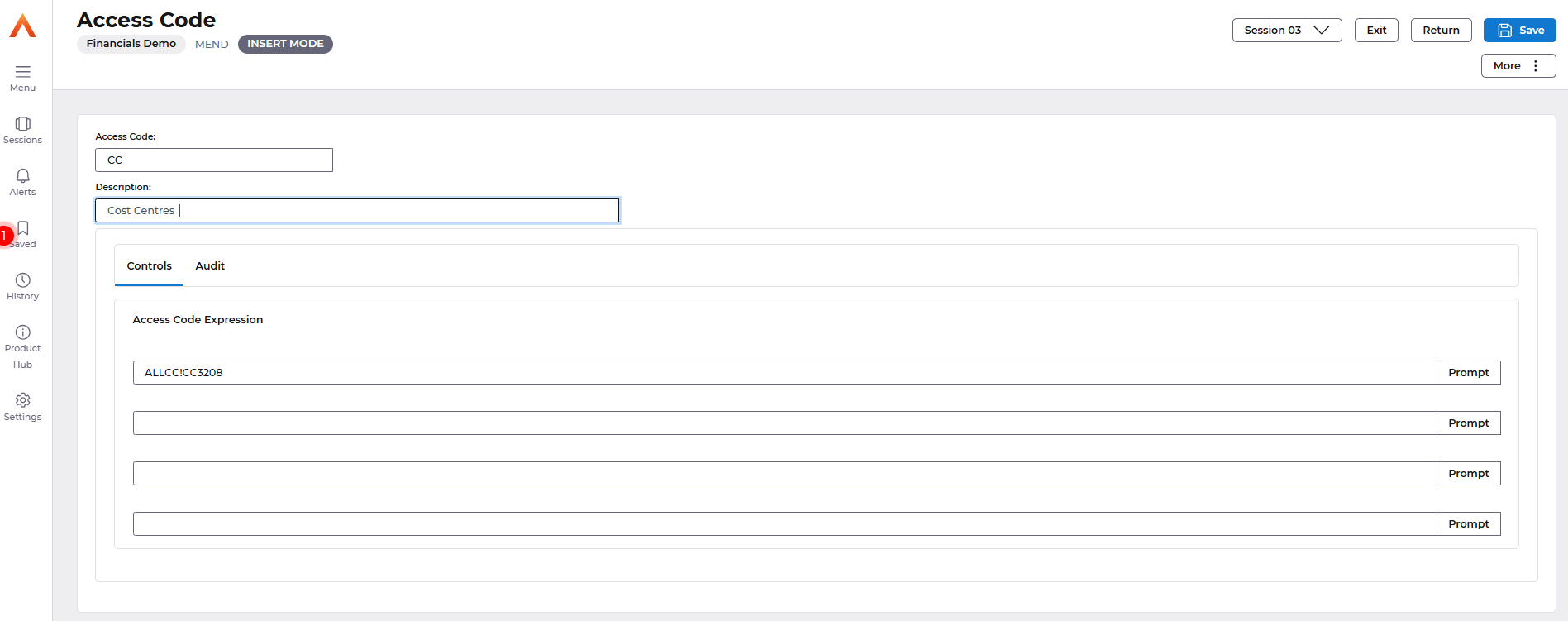
Save once complete,
Many range codes can be created and then entered into an Access code, this can also include multiple parts of the account definition.
Another example would be a range code is set up for all expense nominals.
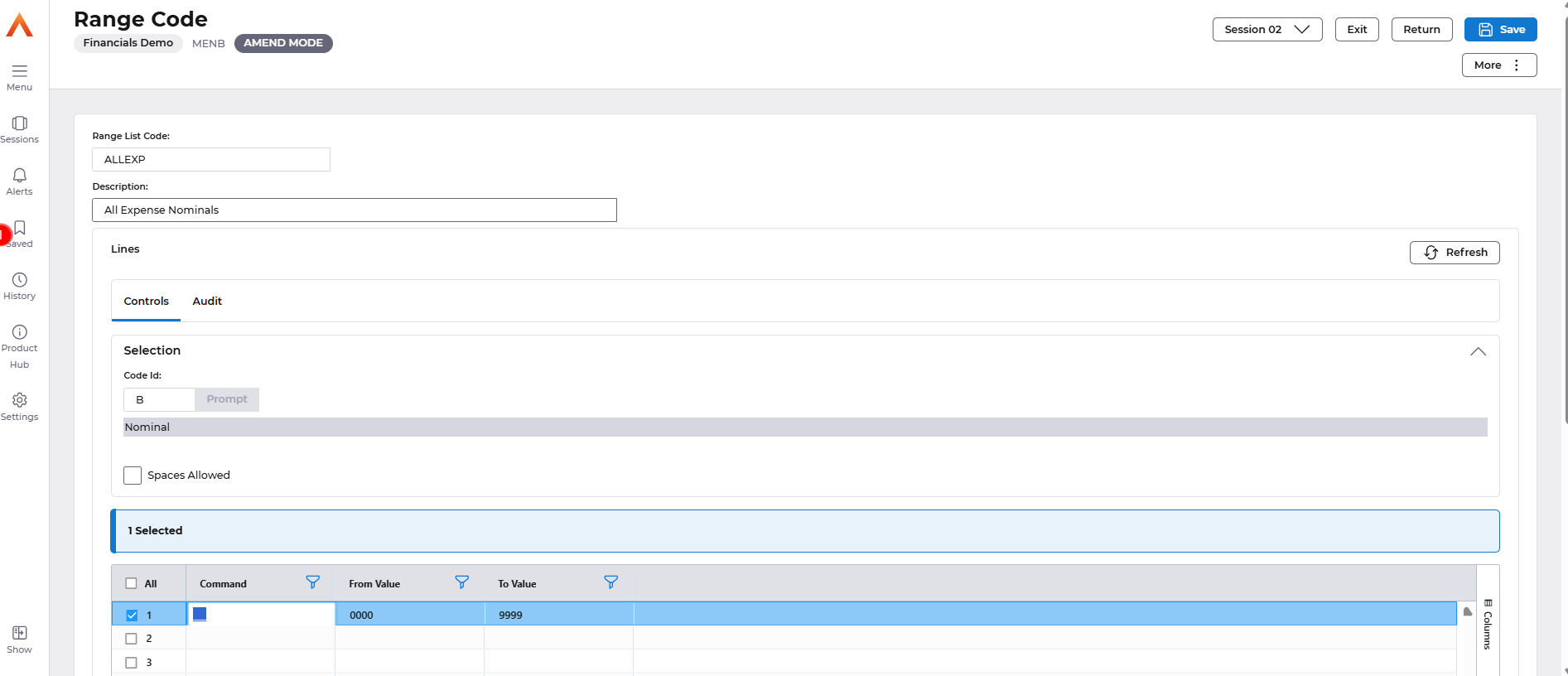
You wish a user to have access to the following.
All expense nominals (ALLEXP) but but Pay nominals (PAY) all Cost Centres ALLCC but not cost centre 3208 (CC3208)
In this example the following access code would be setup.
((ALLEXP!PAY)&(ALLCC!CC3208))
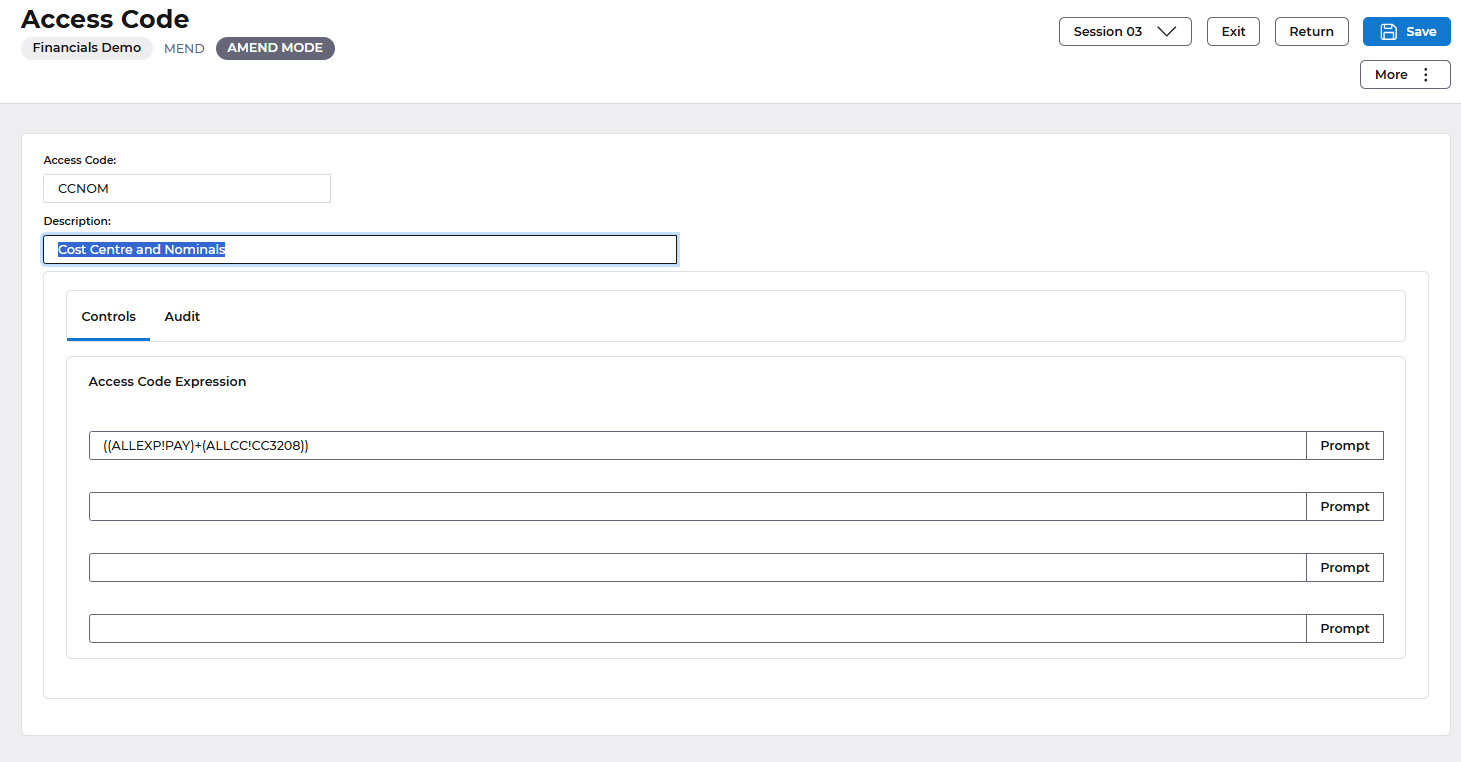
Save.
Remember all access codes then need to be attached via the GL Security Group Access Code option.
